2026-10-29
Point a handheld steamer at a grout line that has been grey for three years and something happens in about four seconds: the line darkens, the film lifts, and a cloth takes it away. Point the same tool at a baking tray carrying a decade of polymerised fat and almost nothing happens, no matter how long you hold the nozzle there. Both outcomes are real, and both repeat predictably. That is the honest starting point for anyone asking whether steam cleaners actually work.
They do, but not universally, and not because of marketing claims about "chemical-free power". Steam works because of a specific energy transfer at a specific temperature range, applied to a specific class of soil on a specific class of surface. When those three things line up, a steam cleaner outperforms sprays, scrubbing and most consumer chemicals. When they do not line up, the machine is not broken and the technique is not wrong — the job simply does not belong to steam.
What follows breaks the question down the way a buyer or a product manager would: what comes out of the nozzle, which soils respond, which surfaces are at risk, how the different machine formats compare, and what to inspect before spending money. The conclusion is up front, and the reasoning follows it.
Yes, steam cleaners work. They reliably remove soap scum, grease films, toothpaste residue, light mildew staining, dust-mite populations in textiles, and the sticky film that builds up on kitchen cabinet fronts. They do this without detergent, with roughly 300–500 ml of water per session, and with far less physical scrubbing than a spray-and-wipe routine.
They also disappoint, consistently and predictably, on burnt-on carbon, on heavypolymerised cooking oil, on unsealed timber, on cold glass, and on anything with an adhesive seam or a heat-sensitive coating. Understanding the difference takes three conditions:
If any one of the three fails, the result is either no cleaning or a damaged surface. If all three are met, the result is typically faster than any alternative method a household already owns.
A steam cleaner is not a hot-water sprayer. It boils water in a sealed chamber and releases saturated vapour through a nozzle, and the useful energy is carried as latent heat rather than as sensible heat. At atmospheric pressure, condensing one gram of saturated steam back to water releases roughly 2,260 joules. Heating that same gram of liquid water from 20 °C to 100 °C takes only about 335 joules. In other words, the vapour phase delivers close to seven times more energy per gram at the point of contact than hot water does — which is precisely why a small tank can do a large amount of work.
Temperature depends on how the machine is built. Unpressurised or lightly pressurised units deliver steam at or slightly above 100 °C at the nozzle. Boiler-type handheld machines operating at roughly 3 to 4.5 bar commonly reach 135–165 °C at the nozzle exit when the element cycles on. Two practical consequences follow. First, the temperature at the surface is never the temperature at the nozzle: a 10 mm air gap, a wet surface or a fast pass drops the contact temperature quickly, which is why slow passes clean better than fast ones. Second, the steam is dry in the thermodynamic sense only if the machine is well designed; excess water droplets in the stream reduce efficiency and leave streaks.
Flow rate matters as much as temperature. A typical handheld consumes 25–40 grams of water per minute, which is why a 350 ml tank runs 10 to 15 minutes rather than two. Canister machines with 1.5–2 litre tanks run 40 to 60 minutes. If a specification sheet quotes only wattage and pressure but not continuous steam duration, it is describing the heater rather than the working session.
Most disagreements about steam cleaners come from comparing notes on different soils. The table below sets expectations by job rather than by product, based on how each soil responds to 100 °C-plus vapour and mechanical follow-up.
| Soil or contamination | Typical surface | Realistic outcome | What improves the result |
|---|---|---|---|
| Soap scum and hard-water film | Glazed tile, glass shower panels, chrome | Very good; film lifts within seconds and wipes clear | Slow pass, squeegee immediately behind the nozzle |
| Kitchen grease film | Stainless steel, painted cabinet fronts, range hoods | Good; grease liquefies and transfers to cloth | Two passes on heavily coated areas, fresh cloth per zone |
| Grout discolouration | Cementitious grout, sealed or unsealed | Good on surface film; moderate on deep staining | Nylon grout brush while the grout is still wet and hot |
| Dust mites and allergens in textiles | Mattresses, pillows, upholstery | Good; contact heat above 60 °C is lethal to mites | Slow overlapping passes, 10–15 seconds per 30 cm |
| Bed bug adults and nymphs | Seams, frames, skirting gaps | Good with direct contact; eggs need sustained heat near 70 °C | Very slow passes, repeat inspection, professional follow-up |
| Bacteria and viruses on hard surfaces | Worktops, bathroom fittings, door handles | Good on contact; no residue and no resistant strains | Clean visible soil first, then steam for contact time |
| Burnt-on carbon and baked fat | Oven interiors, grill pans, baking trays | Poor; surface softens slightly but does not release | Chemical or long soak; steam is the wrong tool here |
| Wax, polish and oil finishes | Furniture, sealed timber, some vinyl | Removes the finish, not the dirt | Do not use steam on these surfaces at all |
Two entries in that table deserve emphasis. Grout is the job steam was effectively designed for, because the vapour penetrates the porous cement skin and lifts soil that a mop pushes deeper. Carbonised oven fat is the job that generates the most negative reviews, because the machine is being asked to do something chemistry normally handles. Neither outcome says anything about build quality.
In a bathroom, a handheld unit with a nylon brush attachment clears soap scum from tile and glass in roughly half the time of a spray, dwell and scrub cycle, largely because no rinsing step is needed. A 5 m² shower enclosure typically takes 20 to 30 minutes including wipe-down. Chrome fittings come up bright without residue, and the same pass reaches the silicone seam where mildew starts.
In a kitchen, steam handles the grease film that accumulates on cabinet fronts above the hob, on extractor hoods, and around handles. It also reaches the seams of refrigerator gaskets and the tracks of sliding doors, areas where liquid cleaners pool and stay. Window and door tracks are one of the clearest wins: the dirt is loose, the geometry is awkward, and steam plus a cloth removes it in a single movement.
In textiles, the case is different but well supported. Mattresses, pillows and upholstered furniture harbour dust mites whose thermal death point sits around 55–60 °C, which steam exceeds comfortably. Ten to fifteen seconds of contact per 30 cm of surface, applied slowly and overlapped, is enough to reduce populations substantially and to refresh odour-causing biological residue. The same technique works on car seats and carpets, provided the fabric is colourfast and the machine does not overwet the foam underneath.
Around the home more broadly, steam is effective on children's plastic toys, pet feeding areas, bin interiors, fridge shelves after a quick empty, tile floors via a steam mop, and the rubber seals of washing machines. In each case the soil is a film, the surface tolerates heat, and there is an easy way to remove what lifts.
The failure modes are worth naming precisely, because they are the reason some buyers conclude the category does not work. Carbonised deposits are chemically cross-linked and need saponification or solvent action; 100 °C vapour softens the top layer and no more. Carpet cleaning is a different process entirely — steam loosens soil in the pile but leaves it there unless it is extracted, so a steamer used alone on a carpet often makes the fibre damp and the dirt redistributed rather than removed.
Exterior automotive paint is another common mistake. Modern clear coats are thin and heat-sensitive, and a concentrated nozzle held in one place can dull a panel or lift a wax layer unevenly. Leather, silk, suede and printed synthetic fabrics react badly to direct vapour. Electronics, including keyboards and TV panels, should never see steam because condensation inside a housing is a short-circuit risk that appears hours later.
Porous natural stone, unsealed hardwood and laminate with a resin core are moisture risks rather than heat risks: the vapour penetrates, the substrate swells, and the damage shows up days afterwards as a lifted edge or a cloudy patch. Adhesive seams on vinyl tile and some engineered flooring soften at steam temperatures and can release under the weight of the machine. A fuller list of restricted materials is worth reading before the first session; our own reference on materials that should never see steam covers the edge cases in more detail.
Finally, steam does not replace extraction. Anywhere soil has to leave the building rather than be wiped off a hard surface, a wet vacuum or a carpet extractor is doing the real work.
These two categories get confused because both are sold as "deep cleaning". A steam cleaner delivers dry vapour at 100 °C or more and relies on a cloth or brush to pick up what it loosens. A carpet cleaner injects heated solution and immediately extracts it with vacuum pressure. One sanitises and releases; the other suspends and removes.
For hard surfaces, grout, glass, mattresses and car interiors, steam is the more versatile tool and needs no consumables. For wall-to-wall carpet with embedded grit, pet accidents or a spilled drink, extraction is the only method that actually removes the material. Households with both a steamer and a small extractor cover the full range; households with only a steamer should not expect carpet shampoo results from it.
Most dissatisfaction with steam cleaners is a format mismatch rather than a performance problem. A 300 ml handheld is superb on grout lines and useless on a 40 m² floor, not because it cleans badly but because it needs refilling every twelve minutes. Format should be chosen from the largest job in the house, not the smallest.
| Format | Tank capacity | Practical run time | Best suited to |
|---|---|---|---|
| Handheld pressurised steamer | 250–400 ml | 10–15 minutes continuous | Grout, bathroom fittings, hobs, tracks, upholstery spot work |
| Canister with hose and tools | 1.0–2.0 litres | 40–60 minutes | Whole-room cleaning, floors plus detail tools in one session |
| Steam mop | 300–500 ml | 15–25 minutes | Sealed hard floors, fast daily maintenance over large areas |
| Garment or multi-purpose steamer | 200–350 ml | 8–15 minutes | Curtains, upholstery, bedding refresh, light surface work |
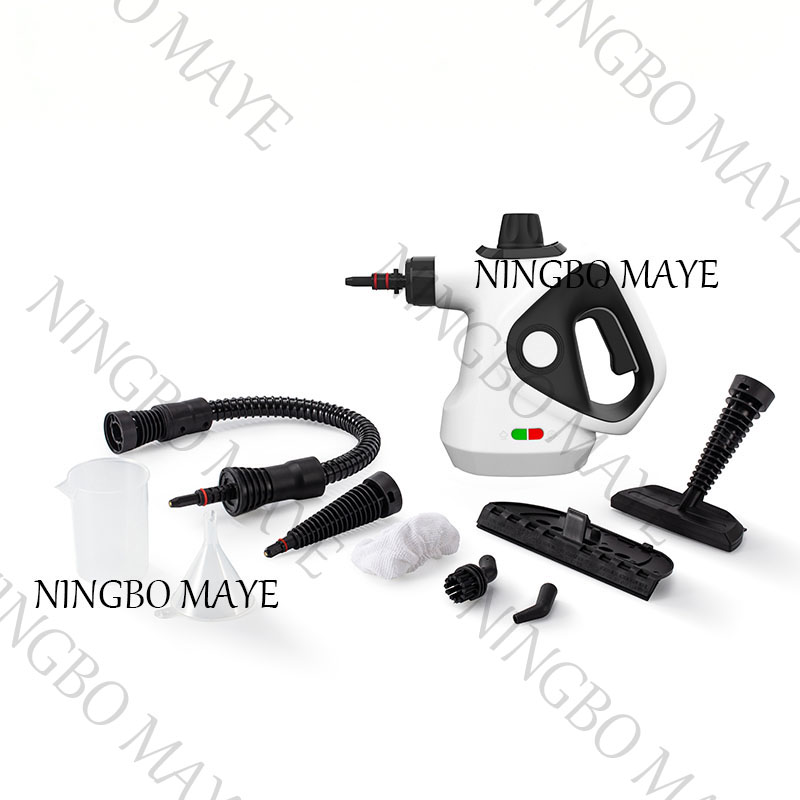
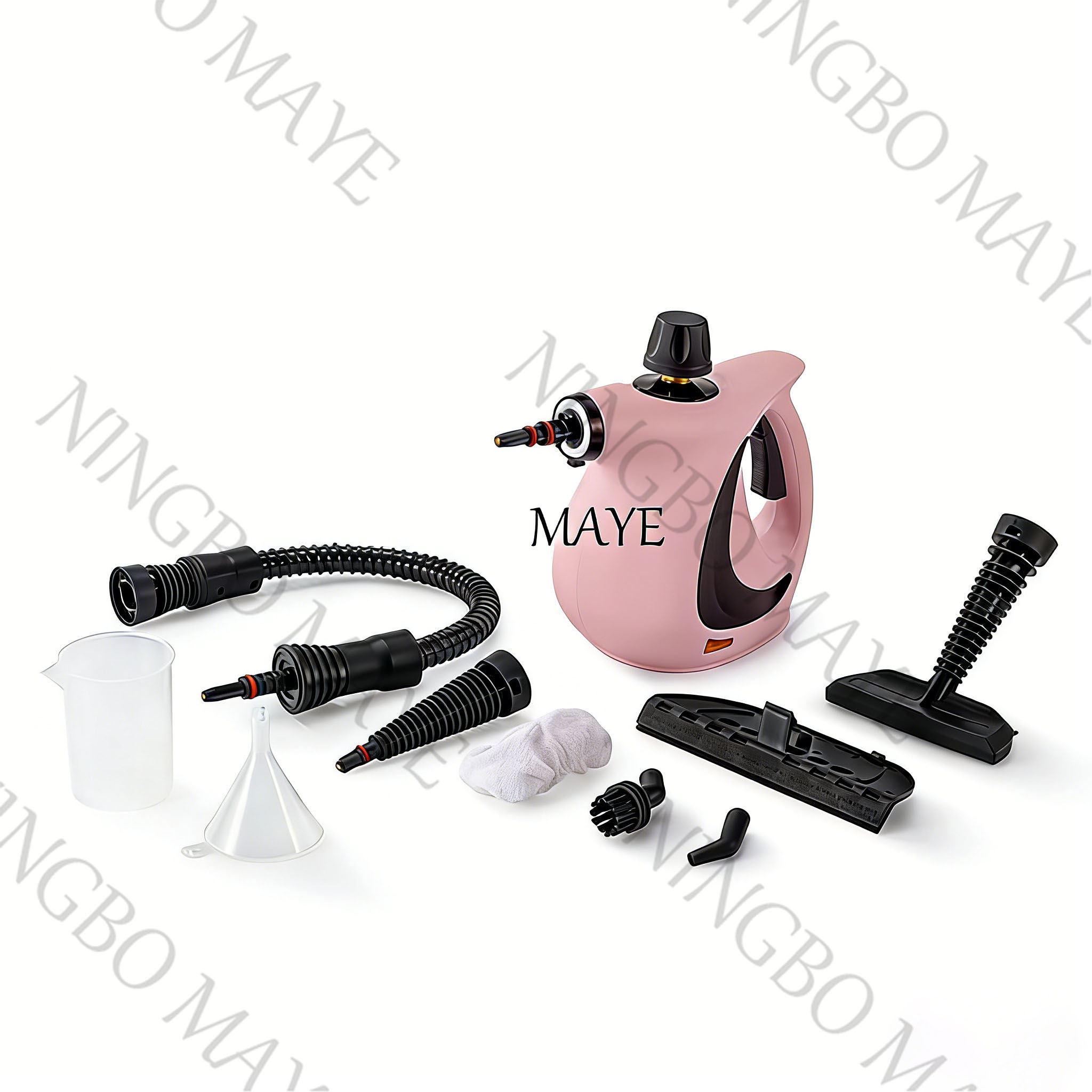
For households that want one machine, a canister with a hose covers the widest range because the tools change rather than the machine. For apartments and detail-focused buyers, a pressurised handheld is usually the better purchase; an example of that format in our own line is the  TM-388 Handheld Steam Cleaner with Interchangeable NozzlesA lightweight handheld steamer with rapid 1–3 minute heating, a 250 ml working tank and nine accessories for multi-surface home cleaning.View Product →, which pairs a compact boiler with interchangeable nozzles for grout, glass and textile work.
Scale is the single most common cause of a steam cleaner losing performance within a year. Tap water in hard-water regions can carry 200–400 mg/l of dissolved calcium and magnesium. Boiled repeatedly inside a small chamber, those minerals precipitate onto the element and the outlet, and the first symptoms are subtle: longer heat-up, a spitting nozzle, uneven steam, and a machine that needs two passes where one used to do.
Distilled or demineralised water below roughly 30–50 mg/l hardness prevents the problem almost entirely and costs a few cents per session. If tap water is the only practical option, descale on a schedule tied to hardness — monthly in very hard areas, quarterly in soft-water areas — using the manufacturer's recommended method rather than improvised acids, which can attack seals. Never add vinegar to the tank of a machine that does not explicitly permit it: the acetic acid attacks silicone and EPDM components over time and shortens the working life of the appliance.
Heat damage is cumulative and often invisible until it is not. The table below gives approximate heat deflection temperatures for common polymer families; specific grades vary, and a thin walled part reaches its limit far faster than a thick one.
| Material | Approximate heat deflection temperature | Steam exposure guidance |
|---|---|---|
| Rigid PVC | 55–70 °C | Avoid; warping and colour shift are likely |
| ABS | 80–100 °C | Short passes only, keep the nozzle moving |
| Polypropylene | 100–120 °C | Generally tolerant; avoid sustained contact |
| Polycarbonate | 128–138 °C | Tolerant, but surface haze can develop |
| Borosilicate or tempered glass | Above 150 °C | Safe once at room temperature or above |
| Cold soda-lime glass | Thermal shock limited | Risk of cracking; warm gradually or avoid |
Beyond polymers, three rules cover most of the risk. Never steam cold glass in a cold room, because the differential across the pane can exceed what the material tolerates. Never hold the nozzle within 10 mm of a painted or printed surface for more than a couple of seconds. And never steam a surface whose finish you have not tested in an inconspicuous area, especially lacquer, matte automotive paint and waxed timber.
Specification sheets reward careful reading. The numbers that predict satisfaction are continuous steam duration, heat-up time, nozzle temperature at the exit rather than at the element, and the range of tools included. Wattage alone says little: a 1,500 W element in a 250 ml boiler heats fast and runs dry quickly, while a 1,000 W element in a 400 ml boiler may deliver a longer usable session.
A practical checklist for a first purchase:
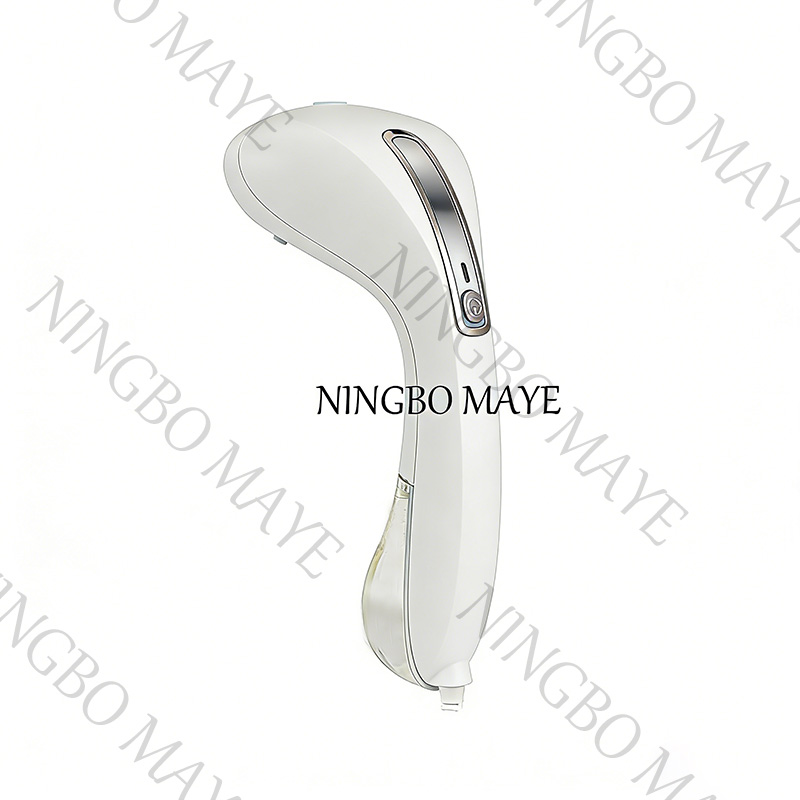
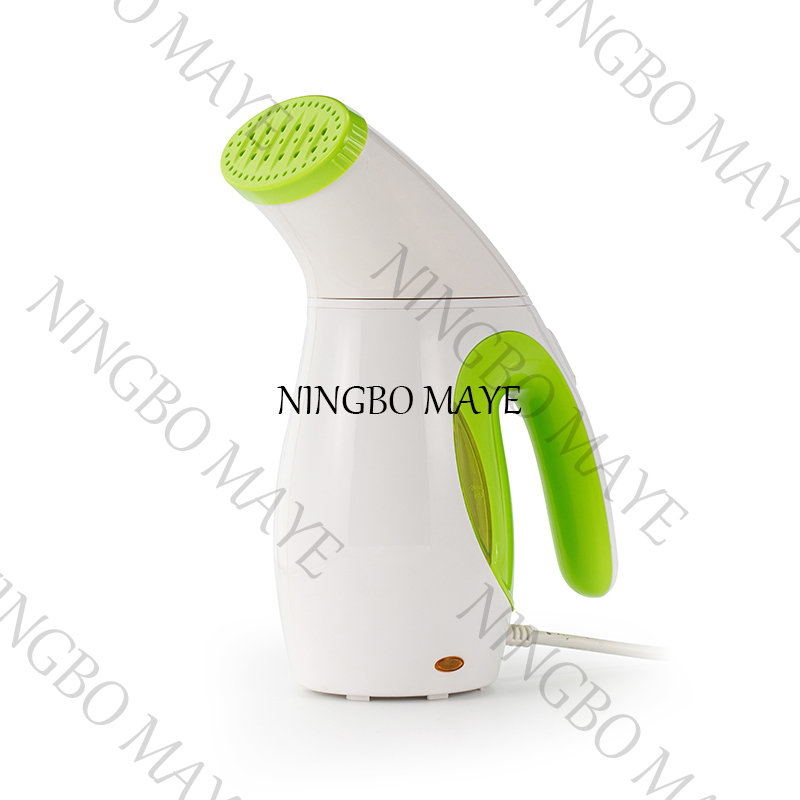
Weight when full is the specification buyers most often overlook. A 2-litre canister weighs around 5 kg filled, which becomes noticeable on stairs. Our own  TM-198 Handheld Garment Steamer and Mite RemoverA mid-capacity handheld with 800W/200W steam modes and a 200 ml tank for garments, curtains, sofas and mattresses.View Product → sits in the mid-capacity handheld bracket where the trade-off between run time and portability is most balanced.
Performance claims are easy to publish and hard to verify, but a steam cleaner can be assessed in twenty minutes with four checks that need no instruments.
Run all four in the same session and most of the marketing language becomes irrelevant. A machine that passes all four will satisfy the jobs in this article; one that fails the glass or recovery test will frustrate regardless of price.
The first component to degrade is almost always the heating element, and the cause is almost always scale. The second is the seal set — tank cap O-rings, hose couplings and the safety valve — where hard water deposits and heat cycling cause hardening and slow leaks. The third is the hose or the tool coupling, which fails at the crimp rather than the tube. Electronics failures are comparatively rare in boiler-type machines because the control circuit is simple.
Housing design matters more than buyers expect. Steam cleaners live in humid bathrooms and are handled with wet hands; a housing that traps condensation around the switchgear will fail earlier than one with a proper gasket and drainage path. This is one reason we pay attention to tooling and mould design at our Yuyao facility, where injection moulding, assembly and inspection sit in the same building rather than across a supply chain. A moulded housing with consistent wall thickness and a correctly seated seal is a reliability decision, not a cosmetic one.
For buyers evaluating a long-life platform, the  TM-168 4-in-1 High-Temperature Handheld Steam VacuumA 1100W handheld steam vacuum producing up to 120°C steam, with multiple accessories for floors, curtains, sofas and commercial cleaning.View Product → illustrates the serviceable approach: accessible seals, a documented descale routine and a nozzle set that can be replaced independently of the boiler.
For importers, private-label brands and retail buying teams, the question "do steam cleaners work" is really a question about returns rates. Three factors drive them: function, safety documentation and packaging survival through distribution.
On function, insist on a run-time specification measured at the nozzle rather than at the element, and on a drop test of the assembled unit after thermal cycling. A machine that passes a bench test cold can leak at the cap after ten heating cycles. On documentation, the relevant certificates depend on the destination: CE and GS with a recognised test house for Europe, UL or ETL for North America, plus RoHS and PAHS for material compliance, and E-mark only where automotive accessories are involved. Our production has been audited against ISO 9001 and by international retail chains, which in practice means the quality system is documented rather than asserted.
On packaging, the failure mode is almost always the tank cap or the nozzle accessory bag, not the housing. Retail programmes that survive their first season usually specify individual accessory bagging and a carton compression figure before artwork is approved.
Running costs are low enough to be almost irrelevant. A 1,000 W handheld used for 12 minutes consumes about 0.2 kWh, which is a few cents at most domestic tariffs, plus the water. Consumables are limited to distilled water and occasional replacement seals. The comparison that matters is time.
On a soap-scummed shower panel, a spray, dwell and rinse cycle takes roughly 10 to 15 minutes plus drying. Steam takes 5 to 8 minutes with no rinse and no residue. On grout, the gap widens, because a brush and detergent demands a rinse that steam does not. On burnt oven fat, steam loses badly: 20 minutes of steam achieves less than 10 minutes with an alkaline gel. Being honest about which of those three situations dominates your cleaning week is a better guide than any feature comparison.
There is also a hygiene argument that holds up: no detergent residue remains on food-contact surfaces, no fragrance is released into the air, and no resistant bacteria are selected for, because the mechanism is thermal rather than chemical.
Steam cleaners work, and they work best on the jobs that dominate real bathrooms, kitchens and vehicle interiors: soap scum, grease films, grout, glass, textile refresh and hard-surface sanitation. They are genuinely faster than chemicals for those tasks and require no rinsing. They fail on carbonised deposits, on embedded carpet soil, and on any surface that cannot tolerate 100 °C plus moisture, and no amount of technique changes that.
The purchase decision therefore reduces to two questions. Does the largest cleaning job in your home involve a heat-tolerant hard surface or a textile? And does the chosen format have enough tank and run time to finish that job without a refill? A yes to both means steam will earn its shelf space. A no means the money is better spent elsewhere, and no specification sheet will fix the mismatch.
Related Products

Address
East Zone Development Zone Lingshan Town Yuyao City Zhejiang P.R.C.
Tel
+86-18905840666 / +86-574-62067822
+86-15905848828
QR CODE
 Wholesale Multifunctional Steam Cleaner Manufacturers

 English
 Español