2026-10-22
A handheld steam cleaner comes back to the service counter with a note that reads "weak steam, then nothing at all." The pump still runs, the indicator light still comes on, and the owner has done nothing unusual except fill the tank from the kitchen tap twice a week for fourteen months. When the boiler is opened, the heater face is coated in a pale, chalky layer about half a millimetre thick. That layer is the fault.
Here is the conclusion up front: for almost every sealed-boiler handheld steam cleaner, steam mop, and garment steamer sold for household use, distilled water is the correct fill. The exceptions are narrow — machines built around an external heater with a boiler you drain after every session, and a few industrial designs where the manufacturer explicitly specifies ordinary tap water and sizes the heating element accordingly. Everything else in this category treats the minerals in water as a slow, predictable consumable cost, paid either at the checkout or at the repair bench.
The rest of this guide gives the reasoning with the numbers that actually decide the outcome: what water hardness means in milligrams per litre, how much solid material a normal household pushes through a steamer in a year, what descaling costs against buying distilled water by the jug, and how to recover a machine that has already been running on hard tap water for a while.
Distilled water is not a marketing preference. It is a specification driven by the physical layout of the appliance: how much water sits in contact with a hot metal surface, how easily that surface can be cleaned, and whether the manufacturer expects the owner to descale at all. A pressurized handheld boiler with a sealed heating element and a 350 ml tank has almost no tolerance for mineral loading. A commercial unit with a separate boiler, a drain tap, and a heating coil you can reach with a brush has a great deal.
The table below maps common designs to sensible fill practice. Treat it as a starting point and let the manual override it — but read the warranty section as well, because "tap water is acceptable" and "scale damage is covered" are two very different statements, and the second one is rare.
| Machine design | Typical heating layout | Mineral tolerance | Recommended fill |
|---|---|---|---|
| Handheld pressurized steam cleaner (3–4.5 bar) | Sealed boiler, element immersed or clamped to the boiler wall | Very low | Distilled or demineralized water only |
| Instant-heat handheld (flow-through heater, steam in 20–30 seconds) | Narrow-bore aluminum or stainless heater block | Very low — the channels are only a few millimetres wide | Distilled or demineralized water only |
| Steam mop with on-demand pump | Small boiler or flash heater, larger tank | Low to moderate | Distilled preferred; a 1:1 blend is tolerable only with soft tap water |
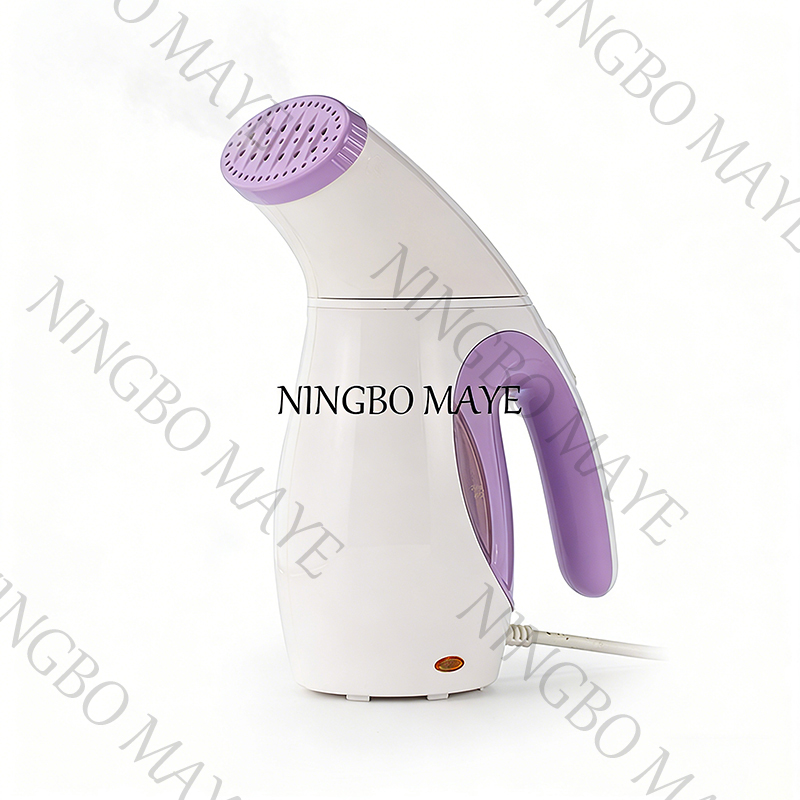
| Garment steamer | Boiler with a steam hose and nozzle | Low | Distilled water |
| Steam iron or steam generator with a serviceable anti-scale cartridge | Cartridge-based ion exchange ahead of the boiler | Moderate, if the cartridge is replaced on schedule | Tap water acceptable within the stated cartridge interval |
| Industrial or commercial unit with external heater and drainable boiler | Separate boiler, accessible coil, daily blow-down | High, with maintenance | Follow the manufacturer's schedule; distilled usually optional |
The practical rule for a household buyer is simple. If the water goes into a sealed vessel you cannot open, treat distilled water as part of the running cost, the same way you treat replacement mop pads or filter bags.
Distillation is a phase change, not a filter. Water is boiled, the vapor is separated from everything dissolved or suspended in it, and the vapor is condensed into a clean container. Calcium, magnesium, bicarbonate, chloride, silica, and the rest stay behind in the boiling vessel. The result is water with a total dissolved solids (TDS) reading typically between 0 and 10 mg/L, and often below 5.
That is why distilled water behaves the way it does in a steam cleaner: when it turns to vapor, it leaves essentially nothing behind on the heater. The same cannot be said for several products that sound similar on the shelf.
These are produced by ion exchange resin rather than boiling. In practice they perform in a steam cleaner much like distilled water, with TDS usually under 20 mg/L. Deionized water can be slightly more aggressive toward certain metals if stored for long periods in an unlined container, but for a fill-and-use cycle in a domestic steamer the difference is not meaningful.
This is where most of the confusion lives. A jug filter removes chlorine, taste, and some organic compounds; it does not remove hardness. Water that tastes clean and leaves no obvious film in a glass can still carry 250 mg/L of calcium carbonate. Bottled spring water is often worse than tap water for a steamer, because bottlers sometimes deliberately add minerals back for taste. "Purified" is a legal category, not a guarantee — it may mean reverse osmosis, distillation, or simply filtration, and the TDS can range from 2 to 80 mg/L depending on the source.
| Water type | Typical TDS | Residue after evaporation | Suitable for a sealed-boiler steamer? |
|---|---|---|---|
| Distilled | 0–10 mg/L | Almost none | Yes — the reference standard |
| Deionized / demineralized | 0–20 mg/L | Almost none | Yes |
| Reverse osmosis | 10–50 mg/L | Small residue | Acceptable in most cases |
| Jug-filtered tap | 100–350 mg/L | Most hardness minerals remain | No — filtering is not softening |
| Bottled spring or mineral water | 150–600 mg/L | Full mineral load, sometimes above tap | No |
| Ion-exchange softened tap | 200–400 mg/L | Sodium salts instead of calcium | Not recommended — still leaves deposits |
| Untreated tap water | 80–600 mg/L | All of it | No, in sealed boilers |
Hard water carries calcium and magnesium bicarbonates in solution. They are stable while cold. Once the water is heated past roughly 60 °C, the bicarbonates break down into insoluble carbonates, carbon dioxide, and water. The carbon dioxide leaves with the steam; the carbonate does not. It plates onto the hottest surface available, which in a steam cleaner is always the heating element or the boiler wall directly above it.
The first consequence is thermal, not structural. Calcium carbonate conducts heat at roughly 2.2 to 2.9 W/m·K. Stainless steel is around 16 W/m·K and aluminum around 200 W/m·K. A tenth of a millimetre of scale is therefore a meaningful insulator, and a half millimetre is a serious one. To deliver the same heat into the water, the element sheath has to run hotter than it was designed to run.
In most handheld steam cleaners the thermostat or thermistor measures water or boiler-shell temperature, not element-sheath temperature. When scale slows heat transfer, the water still reaches its set point — it just takes longer and the element runs hotter to get there. The control loop sees nothing wrong. Meanwhile the sheath is operating well above its design temperature, which accelerates oxidation, embrittlement, and eventually an open circuit or a blown thermal fuse. This is why scale failures often look like electrical failures to the owner.
There is a second, quieter mechanism worth knowing about. Tap water contains chloride, and at the surface temperatures a scaled element reaches, chloride promotes pitting corrosion in stainless steel. A machine with hard water and a slightly undersized element can fail by corrosion before the scale layer is thick enough to be visible through the fill neck.
Suppose your tap water tests at 300 mg/L as calcium carbonate — hard, but entirely ordinary in limestone regions of Europe, the American Midwest, and much of northern China. A handheld steamer that takes 300 ml per fill and is filled twice a week consumes about 0.6 litres a week, or 30 litres across a 50-week year. Thirty litres at 0.3 grams per litre is roughly 9 grams of dissolved mineral entering the boiler annually. If most of it deposits, and on a hot surface most of it does, that is around 3.3 cubic centimetres of calcium carbonate spread across a heater face of perhaps 50 square centimetres — a layer approaching 0.7 mm after a single year. Two years of that is enough to halve steam output on a small boiler.
At 80 mg/L, the same usage deposits under 2.5 grams a year, which is why owners in soft-water cities genuinely can run a steamer for years on tap water and report no problem. Both experiences are real; the water is different.
You do not need a laboratory. Your municipal water report publishes a hardness figure, usually as mg/L CaCO3 or in German degrees, French degrees, or grains per gallon depending on the country. If you are on a private well, a hardness test strip costs a few dollars and is accurate enough to place you in the right band.
| Hardness (mg/L CaCO3) | German degrees (°dH) | Grains per gallon | Description | Practical fill advice |
|---|---|---|---|---|
| Below 60 | Below 3.4 | Below 3.5 | Soft | Distilled still preferred; descale annually |
| 60–120 | 3.4–6.7 | 3.5–7 | Moderately hard | Distilled for regular use; a 1:1 blend is a fallback |
| 120–180 | 6.7–10 | 7–10.5 | Hard | Distilled only; inspect the boiler every 4 months |
| 180–300 | 10–17 | 10.5–17.5 | Very hard | Distilled only; descale quarterly |
| Above 300 | Above 17 | Above 17.5 | Extremely hard | Distilled only; descale every 6–8 weeks of regular use |
Buying distilled water feels like an added expense until it is compared against the alternatives. A household running a handheld steamer at the rate described above needs roughly 30 litres a year, which is about seven or eight 4-litre jugs. In most markets that is the price of one takeaway meal.
| Cost line | Typical unit cost | Frequency | Five-year total |
|---|---|---|---|
| Distilled water, 30 L per year | 0.25–0.60 per litre | Continuous | 40–90 |
| DIY descaling with citric acid | 8–15 per tub | Once a year | 50 |
| Professional descale service | 50–100 per visit | Every two years | 125–250 |
| Replacement steamer after scale failure | 45–120 per unit | Year 2 or 3 instead of year 5+ | 45–120 plus lost use |
The economic argument is not that distilled water saves a fortune. It is that the cost is small, predictable, and paid in convenient instalments, while the alternative is a lump sum that arrives at the least convenient moment — usually mid-job, halfway through cleaning a mattress or a car interior.
Two steam cleaners with identical specifications on paper can have very different water requirements, because the deciding factor is the ratio of heater surface area to water volume, plus how accessible that surface is.
A small pressurized boiler with a 300 ml capacity and a 900–1050 W element concentrates a lot of heat into a small wetted area. Scale forms fast and insulates hard. A larger unit with more water volume and a lower power density gives the same deposit more room to disperse, but it still accumulates over time. Units with a removable anti-scale cartridge or a wide boiler mouth that can be brushed out are the practical middle ground.
For buyers shortlisting a handheld model, three design details matter more than the marketing copy: whether the boiler can be drained and rinsed through an accessible port, whether the element is immersed (better heat transfer, but harder to clean) or clamped externally (easier to clean, but slower to heat), and whether the manual states a descaling interval. A model that specifies "descale every 3 months in hard water areas" is telling you the manufacturer has thought about the failure mode.
If you are comparing a compact handheld against a multi-surface kit, weigh the water question honestly. A larger tank does not reduce scale per litre; it simply means longer sessions between refills, which concentrates more mineral load per heating cycle in the same boiler.
Using the right water but handling it badly still shortens machine life. The routine below is what service technicians generally recommend and what most manuals describe in less detail.
Indefinitely, in a sealed container stored away from heat and light. Once opened, treat it like any other water: use it within a few months, keep the cap on, and do not store it in a container that previously held chemicals or strongly scented liquids.
If the machine has been on tap water for a year or more, descaling is worth doing before the element fails. Citric acid is the usual choice because it dissolves carbonate efficiently and is far gentler on aluminum, silicone, and elastomer seals than acetic acid.
White vinegar works, but it is a compromise. Acetic acid attacks aluminum heater blocks and can harden some rubber seals over repeated exposure. It is acceptable as a one-off on a stainless boiler when nothing else is available, and it should never be left standing overnight.
Chemical descaling removes deposits from wetted surfaces. It does not restore an element whose sheath has already oxidized through, reopen a nozzle blocked by a hard mineral plug without mechanical help, or repair a seal that carbonate grit has abraded. If steam output does not improve after two descaling cycles, the problem is no longer chemical.
Owners who switch to distilled water sometimes keep one habit that quietly cancels the improvement. The list below covers the ones that show up most often in repair reports.
One related mistake sits outside the water question entirely: pointing a pressurized jet at things that cannot take heat or moisture. Knowing what should not be cleaned with a steam cleaner prevents more damage than any water choice.
Sometimes the jug runs out mid-job. In that situation the goal is to minimise mineral input rather than to accept whatever comes out of the tap.
If the machine must run on tap water for an extended period — a rental, a holiday let, a job site — shorten the descaling interval to compensate and accept that this is a wear decision rather than a maintenance one.
On the manufacturing side, the water question is a specification and documentation problem before it is a product problem. A steam cleaner sold into a hard-water market without a clear descaling instruction generates warranty claims that look like electrical faults and cost far more than the unit's margin.
Three things reduce that exposure. First, state the fill requirement plainly on the tank label and in the quick-start card, not only in the middle of a manual. Second, define a descaling interval by water hardness band rather than a single vague instruction. Third, design for serviceability: a drain port, a wide boiler mouth, or a replaceable cartridge turns an unrepairable failure into a routine task.
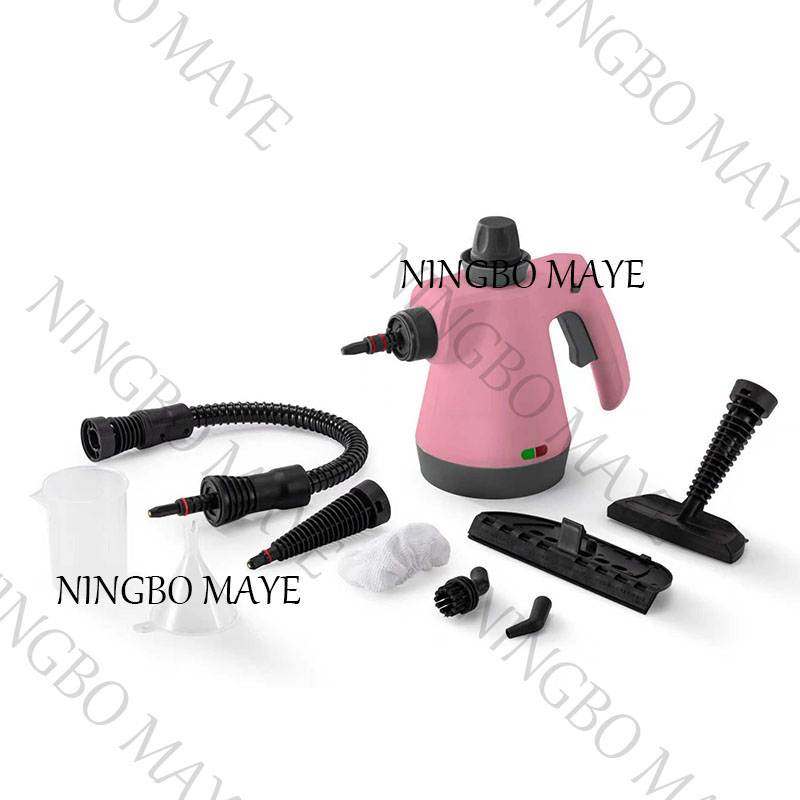
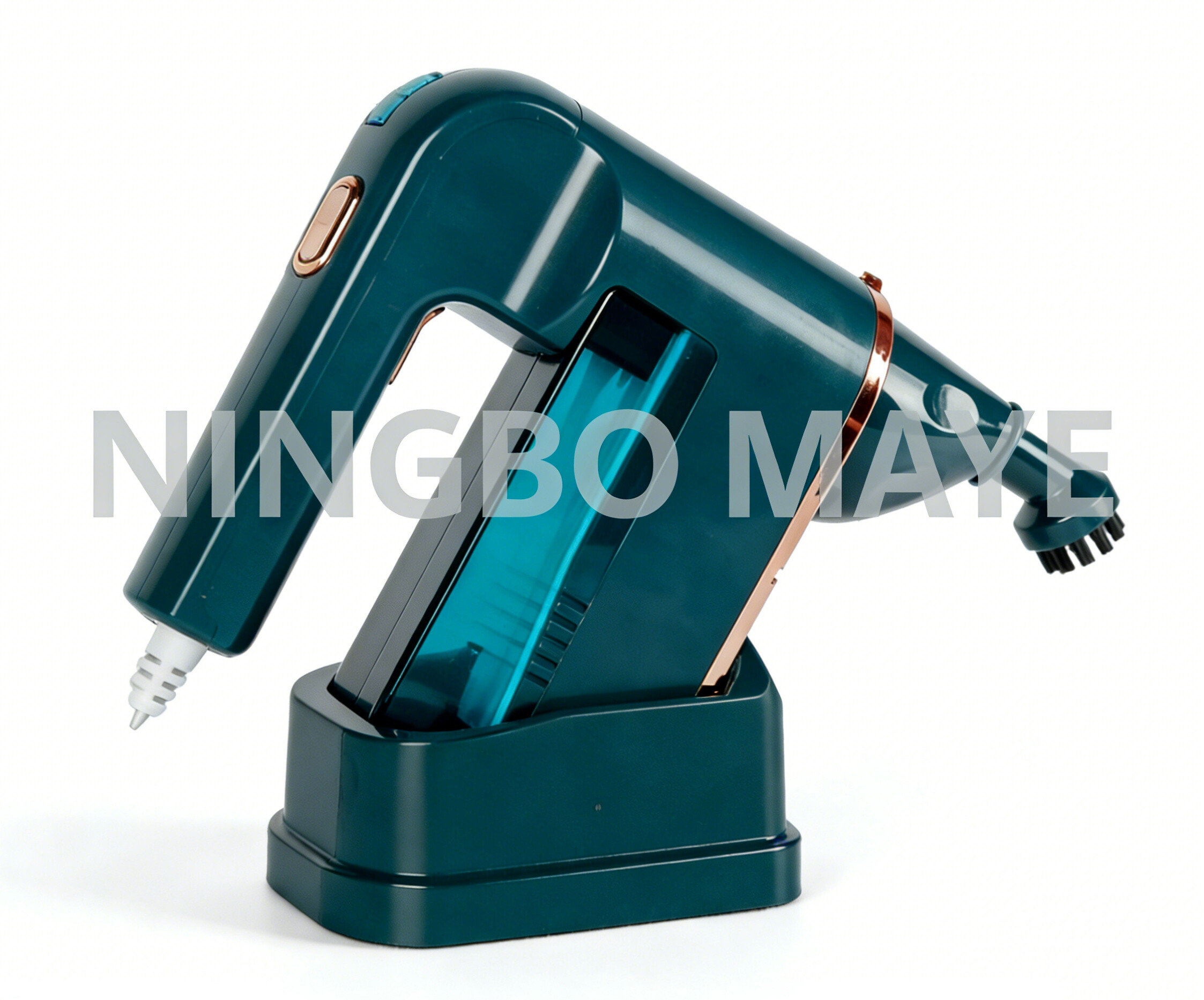
 TM-388 Handheld Multi-Surface Steam Cleaner with AccessoriesA lightweight handheld steamer with 900–1050W power, 250 ml working capacity, fast 1–3 minute heating, and nine accessories for varied household surfaces.View Product →
Element material and power density belong in the same conversation. An immersed stainless element in a small boiler with high watt density is the least forgiving combination in hard water. A clamped element on a thicker boiler wall, or a design that runs a lower watt density, tolerates more deposit before failure. None of these choices removes the need for distilled water; they change how quickly neglect turns into a return.
For private-label and OEM programmes, the household steam cleaner range is the relevant starting point, and the specification sheet should carry the water requirement, the descaling interval, and the test method used to validate both.
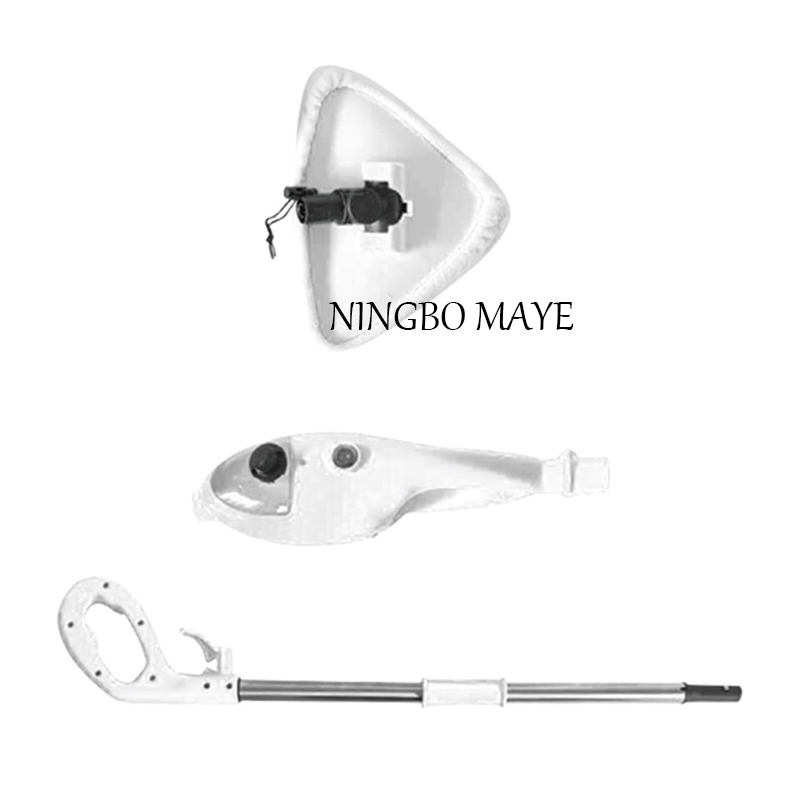 TMSM-001 Detachable Floor Steam Mop for Hardwood and TileA 1300W detachable steam mop with adjustable output, 400 ml tank, 25–30 second heating, and 15 accessories for hardwood, tile, and carpet cleaning.View Product →
Certification matters here too. Units tested to CE, GS, UL, and RoHS requirements are validated for electrical and material safety, not for long-term scale tolerance. That is a separate durability question, and it is worth asking a supplier directly what evidence they have for element life at 300 mg/L hardness.
The whole subject reduces to a routine short enough to fit on a sticker inside the cabinet door.
None of this is glamorous, and that is rather the point. Steam cleaners fail from chemistry long before they fail from electronics, and the chemistry is entirely under the owner's control. A machine fed on distilled water and descaled on schedule will usually outlast its warranty by several years; one fed on hard tap water will produce excellent steam right up until the afternoon it produces none, and the layer that caused it will be too thin to see through the filler neck.
Related Products

Address
East Zone Development Zone Lingshan Town Yuyao City Zhejiang P.R.C.
Tel
+86-18905840666 / +86-574-62067822
+86-15905848828
QR CODE
 Wholesale Multifunctional Steam Cleaner Manufacturers

 English
 Español